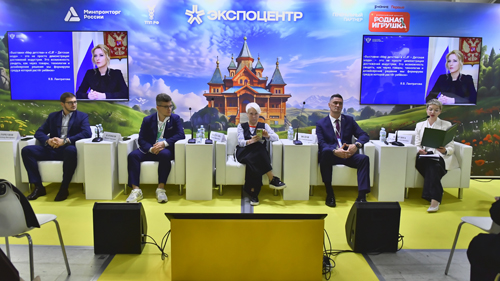
Experts discussed issues of digital literacy in the family
The Panel on the Safe Environment and Digital Literacy in the Family: Challenges and Solutions took place on the first day of the joint conference programme of Mir Detstva 2026 and CJF – Child and Junior Fashion 2026. Autumn. It was organised by the Public Council for Interaction with Civil Society under the High Commissioner for Human Rights in the Russian Federation, the National Project Fund, and EXPOCENTRE with the support of Yana Lantratova, High Commissioner for Human Rights in the Russian Federation.
“Today, the topic of a safe environment and digital literacy in the family is becoming particularly relevant,” the Russian High Commissioner for Human Rights said in her greeting to the panel participants. “Digital transformation affects all aspects of life, and the family finds itself at the forefront as it lays the foundations for a child's safe and conscious interaction with the digital space. Discussing these challenges and finding joint solutions is the most important step towards ensuring children not only comfort and development, but also reliable protection in today’s world.”
According to Yana Lantratova, Mir Detstva and CJF – Child and Junior Fashion are a space for dialogue, exchange of experience, and search for new solutions in the field of child and family policy. “This is not just a demonstration of the achievements of the industry. This is an opportunity to see how, through products, technologies and design solutions, we create an environment in which a child grows up and think about what kind of world we are passing on to new generations,” said the commissioner.
The panel was moderated by Elena Kalgina, Deputy Chair at the Public Council for Interaction with Civil Society under the High Commissioner for Human Rights in the Russian Federation, founder and Executive Director at the National Project Fund for Support of Educational Initiatives. Opening the discussion, she stressed that the topic of the meeting was not chosen by chance. “For a long time we have been dealing with issues related to information security. One of the areas of our work has become countering destructive content, which is increasingly finding its way to our children through the digital environment,” said Elena Kalgina.
She invited the participants to talk about what a safe family environment is and how digital literacy is becoming not just a skill, but a condition for child protection. Elena Kalgina also spoke about a specific step that has already been taken, “On September 9, at a meeting of the Youth Council under the High Commissioner for Human Rights in the Russian Federation, we launched a large competition for anti-bullying projects ‘We have to talk!’ Its objective is to explain to today's children the dangers of bullying in educational institutions.
Lorella Galtsova, a psycholinguist, expert in business communications and human potential development, explained how digital literacy is becoming not just a skill, but a condition for child protection.
Lorella Galtsova identified four challenges for the modern family. These are technology, content, psychology and law: from weak passwords and fakes to cyberbullying and the digital footprint that parents leave by publishing materials about children without their consent. Among the new threats are voice forgery using AI and electronic signature hacking, which could cause a family to lose their home.
Irina Mastusova, Executive Director at the Russian Animated Film Association, Head at the Commission on Cinematography and Animation of the Public Council under the Ministry of Culture of Russian, made a presentation called ‘Characters who are trusted. How high-quality Russian animation creates values and ensures a secure digital environment.’
According to Irina Mastusova, animation remains the most popular genre among children as 81% of children watch cartoons. This imposes a special responsibility on the industry. At the same time, Russian characters are increasingly becoming the most recognizable and beloved among children: after Hollywood studios left the country, Russian animation turned out to be ready to offer popular world-class content.
As Irina Mastusova explained, brands surround childred from all sides, from a morning cartoon to a branded notebook and games with characters, so the most important component of a brand is trust in the character. Such a character becomes a conductor of values: it teaches honesty, teamwork, and problem solving together. The expert also warned about the risks: in user videos, favorite characters may be distorted, giving aggression or obscene speech, and this may come as a shock to a child.
Denis Vodov, Director at the Center for Innovative Competencies in Physical Education and Student Sports at Kosygin Russian State University, called Mir Detstva the main annual venue for the industry, which brings together representatives from different countries. He stressed that children absorb any information as actively and openly as possible. “Whoever is present on the children's goods market forms their philosophy and worldview, even through clothes, through books, through computer games, toys, and animation,” he said.
The expert noted today’s the situation is different from 15 years ago when the government paid little attention to these issues. “It is extremely important that this show gives platform to such events where relevant issues related to animation, computer games, and goods for children are discussed. Despite the fact that there are so many colourful stands around, look at how many people are in the hall: people are listening, actively participating in discussions,” added Denis Vodov.
Mir Detstva 2026 and CJF – Child and Junior Fashion 2026. Autumn are open at Crocus Expo until 18 September.
Press Service, EXPOCENTRE AO